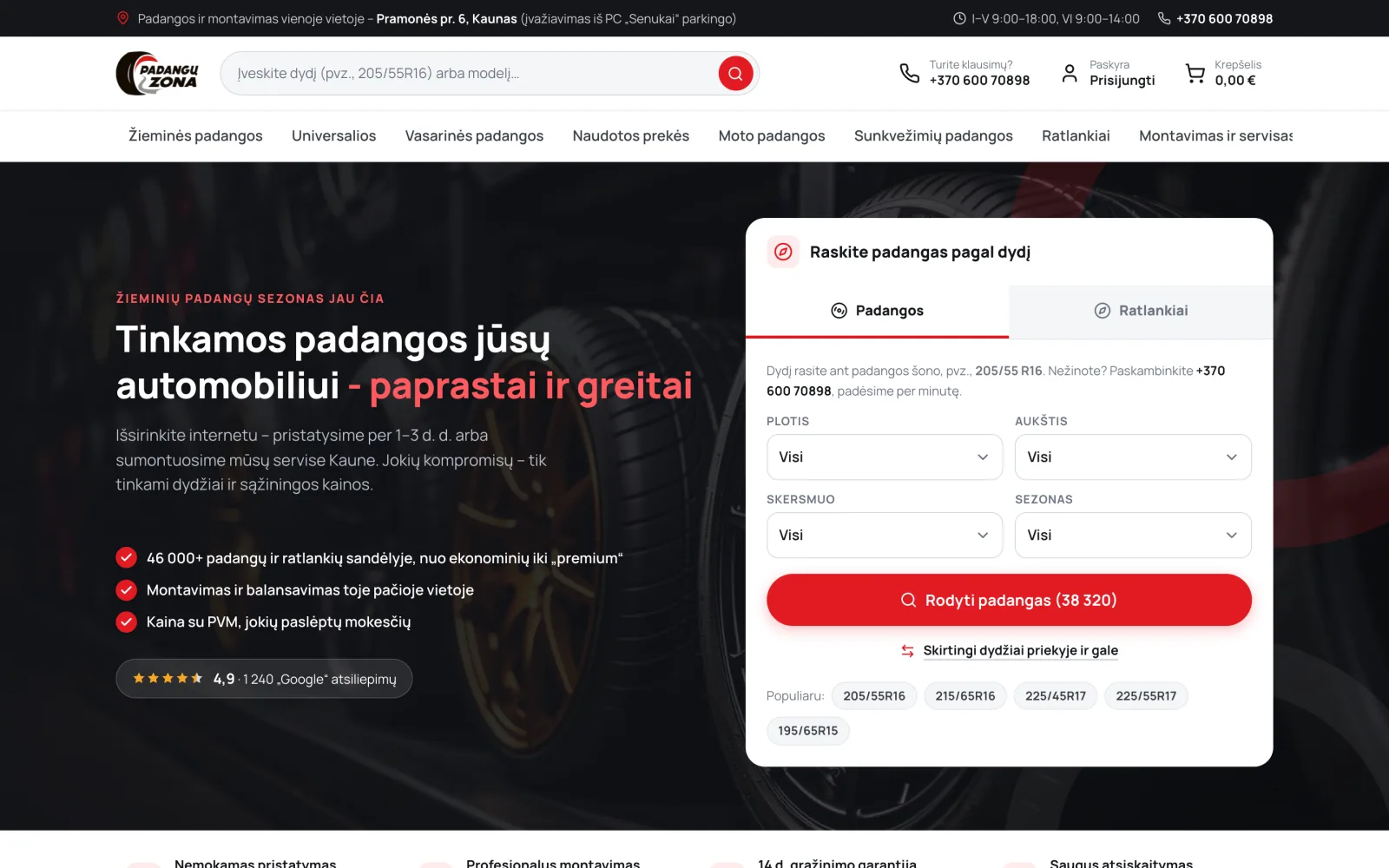
Tyre online store with fitting service booking
Parametric tyre and wheel search, basket, coupons and fitting appointment booking.
B2C and B2B ecommerce with accounting, warehouse and courier integrations. The platform is chosen to fit your needs, not the other way round.
A custom online store is an ecommerce system whose order flow, pricing and integrations are built around a specific business model. It differs from an off-the-shelf platform in that the trading rules are written in code rather than worked around with plugins.
A standard store works well for a simple model: product, basket, payment, delivery. The limits show once the business has rules of its own:
Custom, PrestaShop and WooCommerce are all tools. We choose based on need: for a standard product range with a typical flow, an off-the-shelf platform will be cheaper; for unusual logic, a custom solution will cost less in the long run than ten plugins that conflict with each other and break with every update.
We migrate products, customers and order history, and preserve SEO with a 301 redirect map. Every old URL gets an equivalent, so the rankings and links you have built up keep working.
If the store needs to connect to the rest of your company's systems, see integrations and automation. To bring in traffic, see digital advertising.
When selling to businesses, a store works differently than with private buyers. It usually needs:
Off-the-shelf platforms usually offer these as plugins that conflict with each other. In a custom store they are part of the system from the start.
An online store is launched with the catalogue and core integrations, while B2B logic and new markets are added in later phases.
Every stage ends with a result you can assess before moving on. More on this on our process page.
Public institutions rarely sell online, but paid services, tickets or publications follow the same commerce logic and public sector requirements.
How we work with public institutions is described on the public sector solutions page.
It pays to launch the catalogue with the core integrations first and add B2B logic and new markets in a second phase. We cover market data and how to calculate the total cost of ownership in our article on custom software development cost.
In short: when each approach is the cheaper one.
| Criterion | Off-the-shelf platform | Platform with plugins | Custom solution |
|---|---|---|---|
| Best when | The process is standard | A few add-ons are needed | Trading logic is unusual |
| Time to launch | Weeks | Weeks or months | Months |
| Updates | Simple | Risky, plugins conflict | Controlled |
| Integrations | From the catalogue | Plugins or workarounds | Built to requirements |
| B2B capabilities | Limited | Partial | No limitations |
| Long-term cost | Low, while the standard is enough | Grows with the number of plugins | Predictable maintenance |
When your trading logic is unusual: customer-specific pricing, complex product configurations, B2B order approvals, or stock synchronised with production. If the product range is standard and the process is simple, an off-the-shelf platform will be cheaper and faster.
Yes. We migrate products, categories, customers and order history. SEO is preserved with a 301 redirect map: every old URL points to its equivalent in the new structure, so your rankings are not lost.
Accounting software (for example Lithuanian systems such as B1, Rivilė and Directo), payment providers, courier services with shipment creation and tracking, warehouse or ERP systems, and email marketing tools.
Price lists for registered customers, discount groups, an order approval workflow, deferred payments, ordering by product code and quick reordering from order history.
The platform is a tool, not the essence of what we offer. If a standard platform covers your needs, that is what we use, set up properly without ten conflicting plugins. We build custom when the platform's model contradicts your business logic.
Parametric tyre and wheel search, basket, coupons and fitting appointment booking.
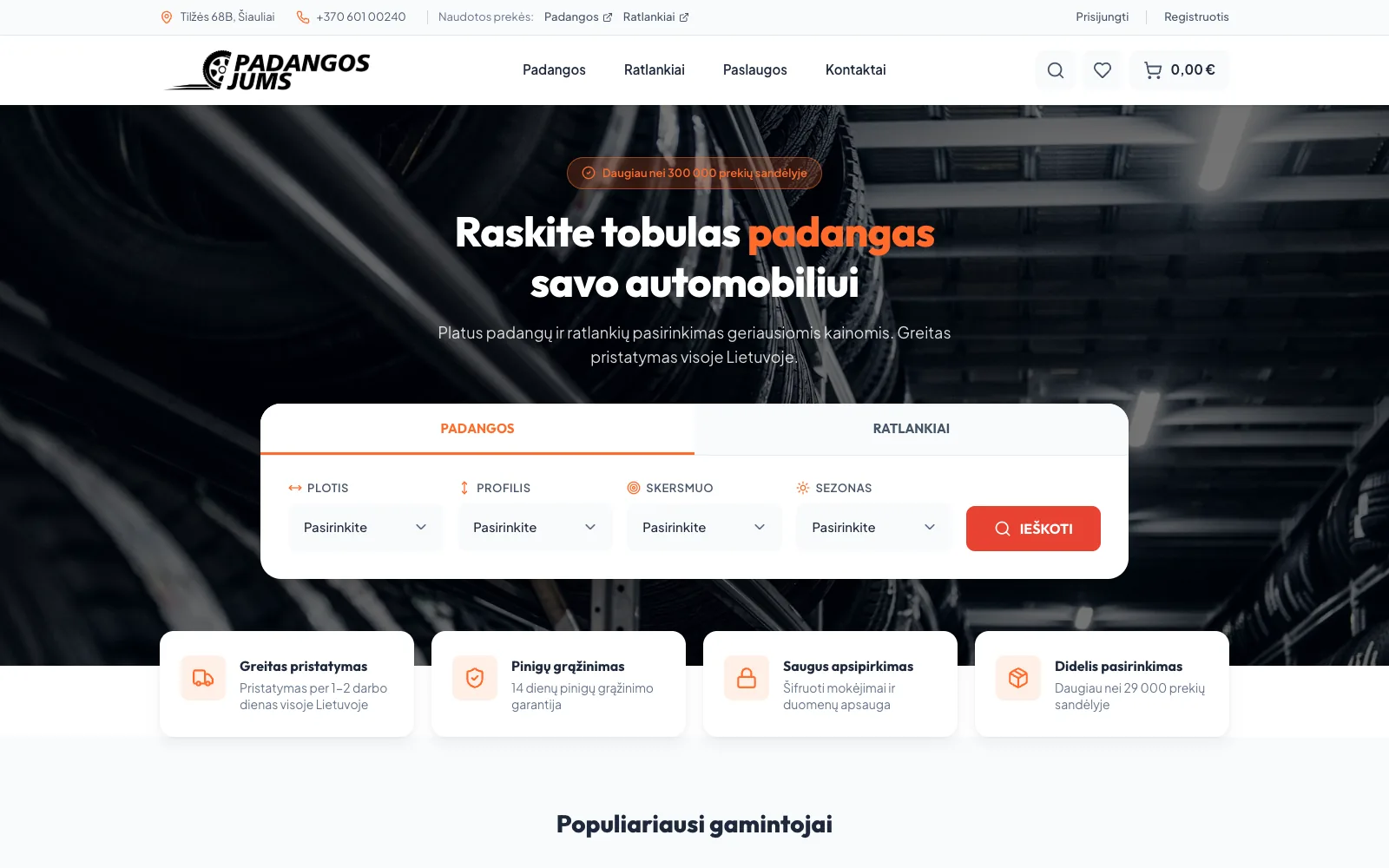
A tyre and wheel store with supplier stock imports, parametric search and product comparison.
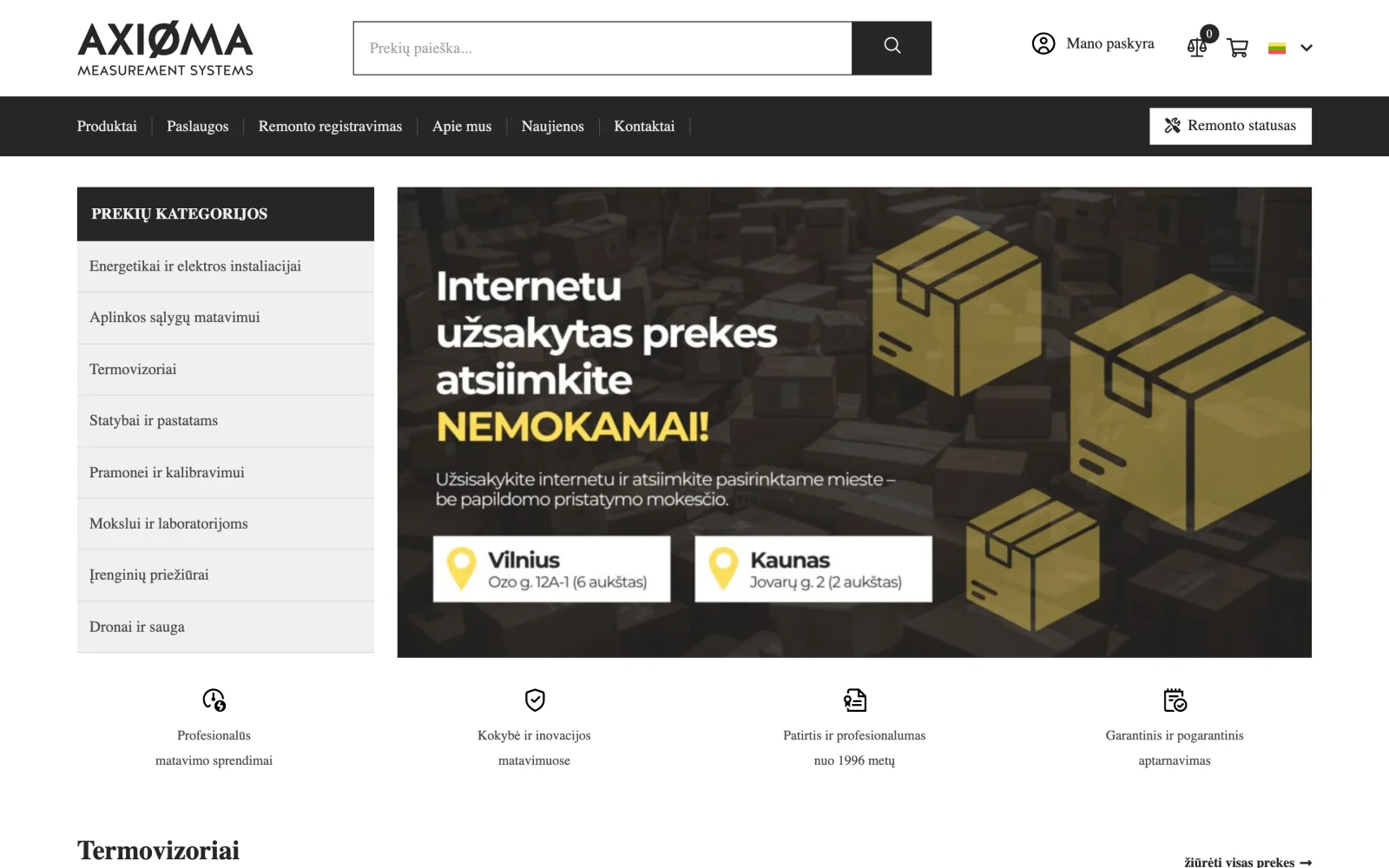
An online store for professional measuring equipment with a catalogue organised by application: construction, industry, laboratories and drones.
Tell us where an off-the-shelf platform no longer fits. We will get back to you within one business day.
Or directly: info@desamedia.lt · +370 686 59999